
Why Most Racquet Sports Decisions Are Still Made on Gut Feeling

The racquet sports industry is growing. Court numbers are rising. New facility concepts are being launched across multiple continents. Investment is flowing into padel and pickleball at a pace that would have seemed improbable a decade ago.
And yet, most of the decisions behind that growth are still made on gut feeling.
Not because the people making them are careless. Not because they lack ambition or commitment. But because the information infrastructure that serious decision-making requires simply does not exist in this sector — not in the way it exists in hospitality, fitness, real estate, or mainstream sports.
That is the core problem. And it affects everyone: operators planning new facilities, investors evaluating opportunities, federations shaping national strategies, and architects designing venues they have never operated.
The racquet sports ecosystem is making consequential decisions — capital allocation, facility design, market entry, programming strategy — on a remarkably thin base of structured, comparable, and reliable information.
This article examines why that is the case, what it costs, and why it matters now more than ever.
The information landscape is fragmented by design
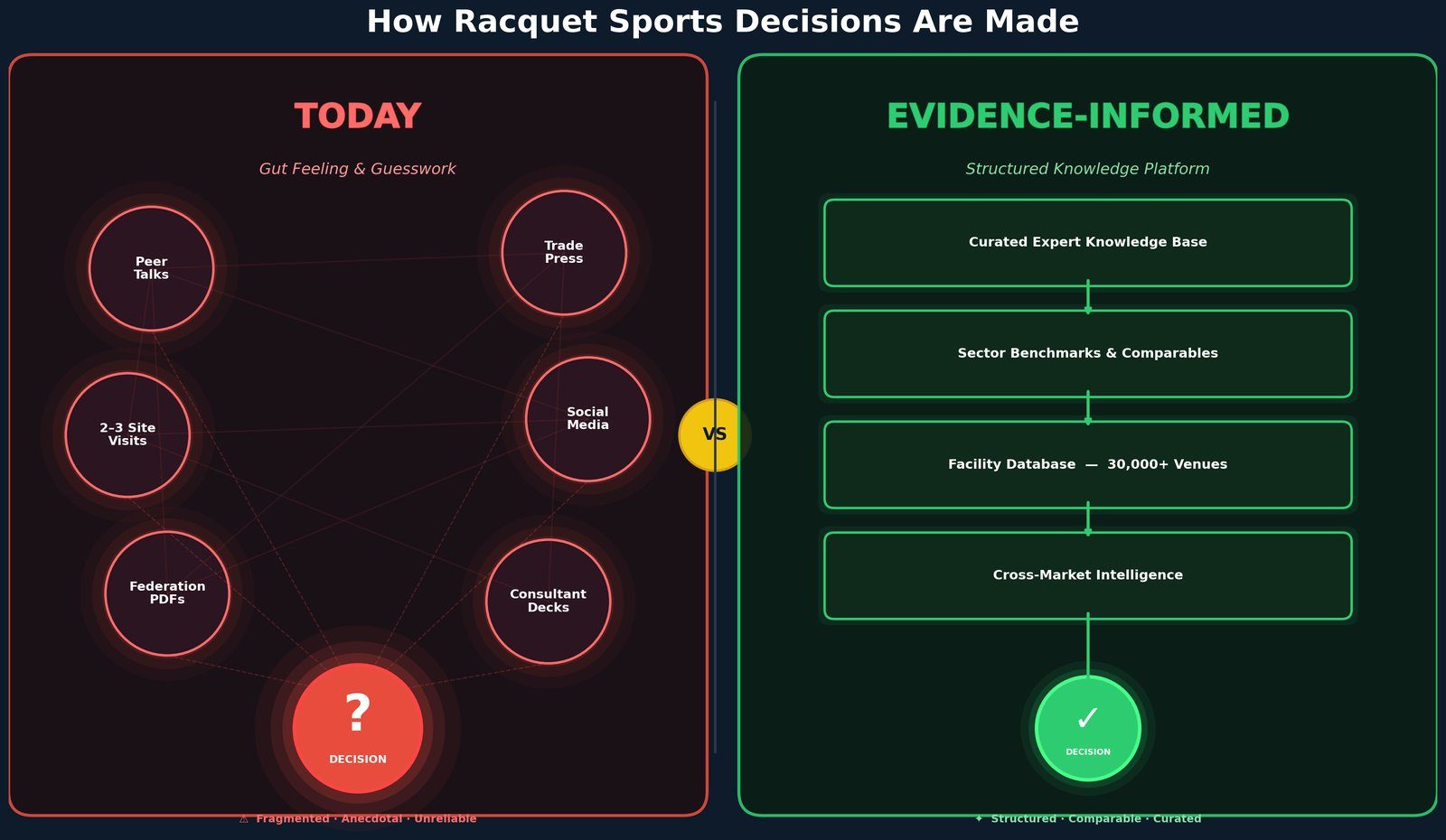
Today vs. Evidence-Informed — How a structured knowledge platform transforms fragmented, anecdotal inputs into disciplined decision-making.
Every mature industry eventually develops its own knowledge infrastructure. Hotel developers have STR benchmarks. Fitness operators have IHRSA data and comparable performance sets. Commercial real estate has standardized yield metrics, occupancy data, and market reports covering virtually every geography.
Racquet sports have none of this.
There is no standardized facility performance database. There are no widely accepted KPIs for court utilization, revenue per court hour, or programming yield. There is no structured global directory of facilities with comparable data on type, orientation, sport mix, pricing model, or operational format.
What exists instead is scattered across dozens of disconnected sources: federation reports with inconsistent methodologies, consultant presentations shared informally, operator experience passed along in conversations, trade press articles mixing advocacy with analysis, and social media threads where strong opinions substitute for structured evidence.
None of this is inherently wrong. Every industry starts with informal knowledge. But the racquet sports sector has now reached a level of capital commitment and strategic complexity where informal knowledge is no longer sufficient.
The gap between the scale of decisions being made and the quality of information supporting those decisions has become a structural problem.
Operators plan facilities without comparable data
Consider the most common and consequential decision in the sector: building or converting a racquet sports facility.
An operator deciding whether to build a six-court padel venue, a mixed-sport facility combining squash and pickleball, or a commercial club with hospitality integration faces a series of interdependent choices. How many courts? Which sports? What pricing model? What target segment? What programming mix? What staffing structure? What break-even timeline?
In most cases, these decisions are made based on a combination of personal experience, visits to a handful of reference facilities, conversations with peers, and a general sense of market momentum.
That is gut feeling dressed up as strategy.
It is not that operators are unaware of the risks. Many are highly experienced and thoughtful. But without access to structured comparable data — what works at what scale, in what market type, under what operating model — even experienced operators are forced to extrapolate from a very small sample of personal observations.
The result is predictable. Some facilities are built at the wrong scale. Some choose the wrong sport mix for their market. Some adopt pricing models that do not match their cost structure. Some invest in design features that add cost without adding revenue. And some succeed largely because they happen to be in the right location at the right time — not because the underlying strategy was sound.
Better information would not eliminate all of these errors. But it would reduce the avoidable ones significantly.
Investors evaluate opportunities without sector benchmarks
The problem is even more acute for investors.
Capital entering the racquet sports sector — whether from private equity, real estate funds, family offices, or individual entrepreneurs — typically arrives without access to reliable sector-specific benchmarks.
What is a reasonable EBITDA margin for a six-court padel facility in a Southern European market? How does court utilization typically evolve over the first three years of operation? What is the relationship between court count and operational efficiency? At what scale do economies of scale begin to matter? How does facility type — commercial versus non-profit versus hospitality-led — affect revenue logic and risk profile?
These are not exotic questions. They are basic due diligence questions that any serious investor would ask. And in most cases, they cannot be answered with reliable, comparable data — because that data has never been systematically collected, structured, or made available.
The consequence is that investment decisions in racquet sports often rely disproportionately on the enthusiasm of the promoter, the visual appeal of the concept, and the general narrative of market growth. Those are starting points, not substitutes for analysis.
In other sectors, this kind of information gap would be considered unacceptable. In racquet sports, it is still the norm.
Why the Information Gap in Racquet Sports Has Persisted
It is worth asking why the racquet sports sector has not yet developed the kind of knowledge infrastructure that other industries take for granted.
Part of the answer is historical. Racquet sports have traditionally been organized around individual sports, each with its own federation, culture, and data practices. Squash, padel, pickleball, tennis, and badminton have developed largely in parallel, with limited cross-sport knowledge exchange. The idea of treating them as an interconnected ecosystem — sharing facilities, audiences, and business logic — is still relatively new.
Part of the answer is structural. Much of the relevant knowledge sits with operators, consultants, and developers who have little incentive to share it publicly. Experience is a competitive advantage, and the sector has not developed the kind of neutral, industry-wide data platforms that exist in hospitality or fitness.
And part of the answer is simply that the sector has been growing fast enough that the gap has not yet forced a reckoning. When markets are expanding, mistakes are easier to absorb. It is only when growth slows or competition intensifies that the cost of poor decisions becomes harder to ignore.
But that moment is approaching. The wave of facility development now underway — particularly in padel and pickleball — is reaching a scale where the margin for error is narrowing. Markets that were undersupplied two years ago are starting to show signs of saturation in some segments. The early movers have learned hard lessons. The next wave of entrants will need better information to avoid repeating them.
What a structured knowledge base would change
Imagine a different scenario.
An operator planning a new facility has access to a structured database of comparable venues — filtered by sport, market type, facility orientation, and scale. They can see how facilities of similar size and format have performed. They can compare pricing models, programming approaches, and operational structures. They can identify the critical thresholds — court count, revenue per court hour, staffing ratios — that separate viable models from marginal ones.
An investor evaluating a market opportunity can benchmark it against structured sector data. They can assess whether the proposed concept is aligned with what the evidence suggests works in that type of market. They can identify red flags early — before capital is committed — and ask sharper questions of the promoter.
A federation developing a national strategy can compare its market against others at similar stages of development. It can see what facility models, programming approaches, and support structures have produced measurable results elsewhere. It can set targets that are grounded in evidence rather than aspiration.
None of this eliminates the need for judgment, local knowledge, or professional expertise. But it shifts the starting point from gut feeling to structured information. And that shift — from intuition to evidence-informed decision-making — is what separates mature industries from developing ones.
The sector is ready for this shift
The racquet sports ecosystem has reached a point where the scale of investment, the complexity of decisions, and the diversity of stakeholders involved all demand a better information foundation.
The question is no longer whether the sector needs structured, curated, sector-specific knowledge. It clearly does.
The question is whether stakeholders will continue to make consequential decisions on the basis of fragmented information and personal intuition — or whether they will invest in the kind of knowledge infrastructure that allows for more disciplined, evidence-informed thinking.
That does not mean replacing experience with data. It means combining them.
The most effective decisions in any sector are made by people who bring deep experience to well-structured information. Neither alone is sufficient. Experience without data leads to blind spots. Data without experience leads to misinterpretation. Together, they produce better judgment.
The racquet sports industry is at an inflection point — not just in terms of growth, but in terms of how it thinks about growth. The decisions being made now will shape the landscape for a decade or more. Whether those decisions are made on gut feeling or on a foundation of structured knowledge will determine how much of the current momentum translates into sustainable value.
That is a choice the sector still has time to make. But not for much longer.
The beta version of the Racquet Sports Ecosystem Intelligence is scheduled to launch in May 2026. If you are an operator, investor, or industry professional who wants early access — to test the platform, challenge its outputs, and help shape a tool built for this industry — we invite you to join our pre-launch program at info@racquetsports.institute .